
Instrument Types in Pittsylvania County Land Records
The Pittsylvania County Circuit Court Clerk records far more than sale deeds. Deeds of trust, plats, certificates of satisfaction, powers of attorney, judgments, and probate papers can all affect or explain a parcel's history. A deed names its parties. It also gives the parcel's legal description. Nothing else is guaranteed. Read the recorded instrument, then compare it with any related releases or court orders before drawing conclusions about the property.
| Deed Type | What It Does | Common Use |
|---|---|---|
| Deed | Records a transfer of an interest in the land. | Compare parties, description, date, and book/page. |
| Deed of trust | Records a security instrument tied to an obligation. | Look for a later certificate of satisfaction or release. |
| Trustee's deed | May document a transfer after a trustee's sale. | Check the related notice and recorded deed. |
| Executor or commissioner's deed | Can move property through an estate or court-directed sale. | Pair with the probate or case file. |
| Plat or certificate of satisfaction | Maps lots or records that an obligation was released. | Use the reference to find related parcels and instruments. |
A deed and a deed of trust differ. The deed conveys an interest in the land. The deed of trust secures a debt, and a later certificate of satisfaction or release records a step toward clearing that lien. Pittsylvania's Circuit Court land records also hold liens, easements, rights-of-way, plats, judgments, and probate transfers. Search by instrument type and party names first. Then read the whole document before concluding anything about the property's present ownership.
WebPAAS Keeps a Detailed Deed Reference Trail
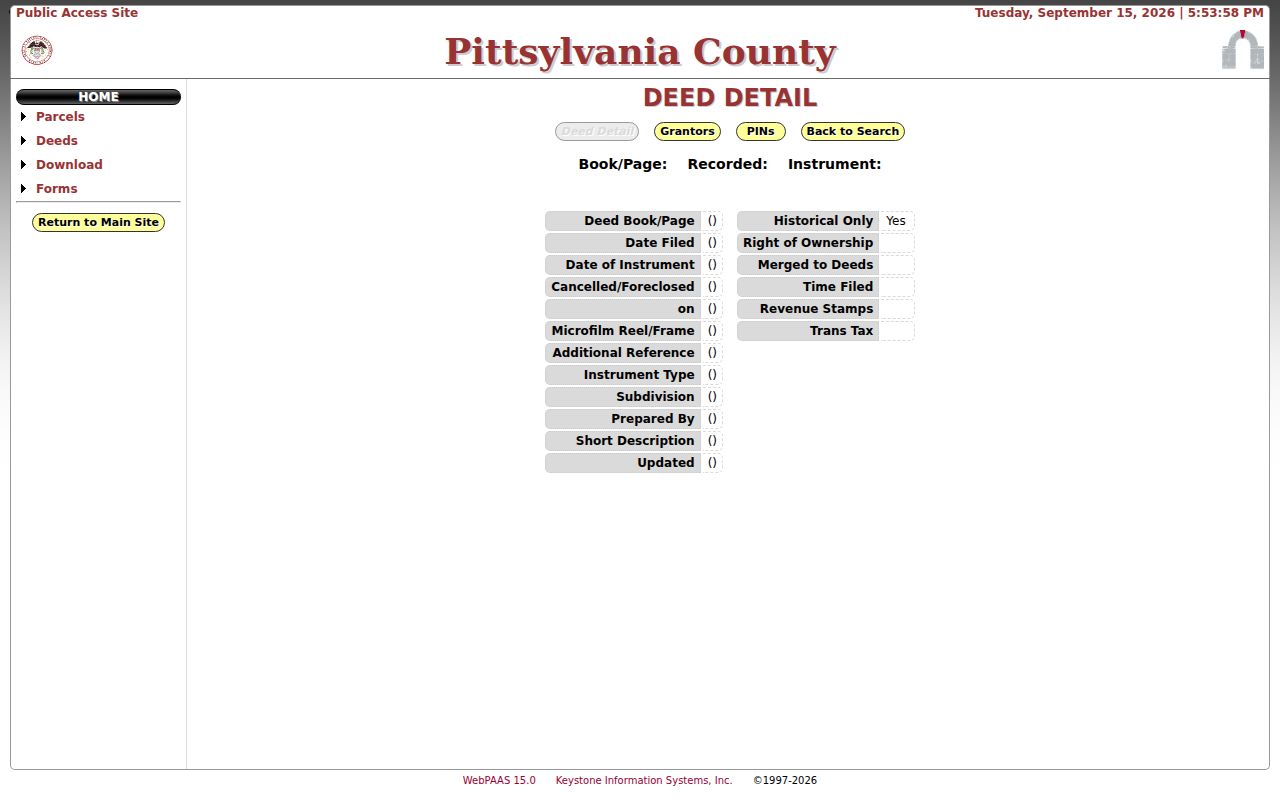
The WebPAAS deed detail screen packs a lot in. It lists Book/Page, Recorded, Instrument, Date Filed, and Date of Instrument. Cancelled/Foreclosed appears with its date. So do Microfilm Reel/Frame, Additional Reference, Instrument Type, Subdivision, Prepared By, and a Short Description. Updated, Historical Only, Right of Ownership, Merged to Deeds, Time Filed, Revenue Stamps, and Transfer Tax complete the set. Grantor and grantee labels depend on the live form.
Use the fields as an inventory. They cannot replace the image itself. A book/page or reel/frame reference helps the clerk pull a copy when the online display stops short. The Historical Only flag and the Merged to Deeds flag explain why an old entry looks unlike a newer one.
The WebPAAS deed detail page shows the field labels themselves, as a blank reference view rather than a populated deed for any named owner.
Sometimes a search result hides the instrument image. Save the reference you find, and ask the clerk about access to the recorded copy.
The County Custody Statement Does Not Set the Web Cutoff
Pittsylvania County says its clerk maintains land records from 1767 forward. That is a custody statement, not a web promise. No page states the earliest year indexed online. The exact image-conversion date is likewise unstated. So a WebPAAS result that starts later does not mean earlier deeds went unrecorded. Custody proves preservation, not complete searchability.
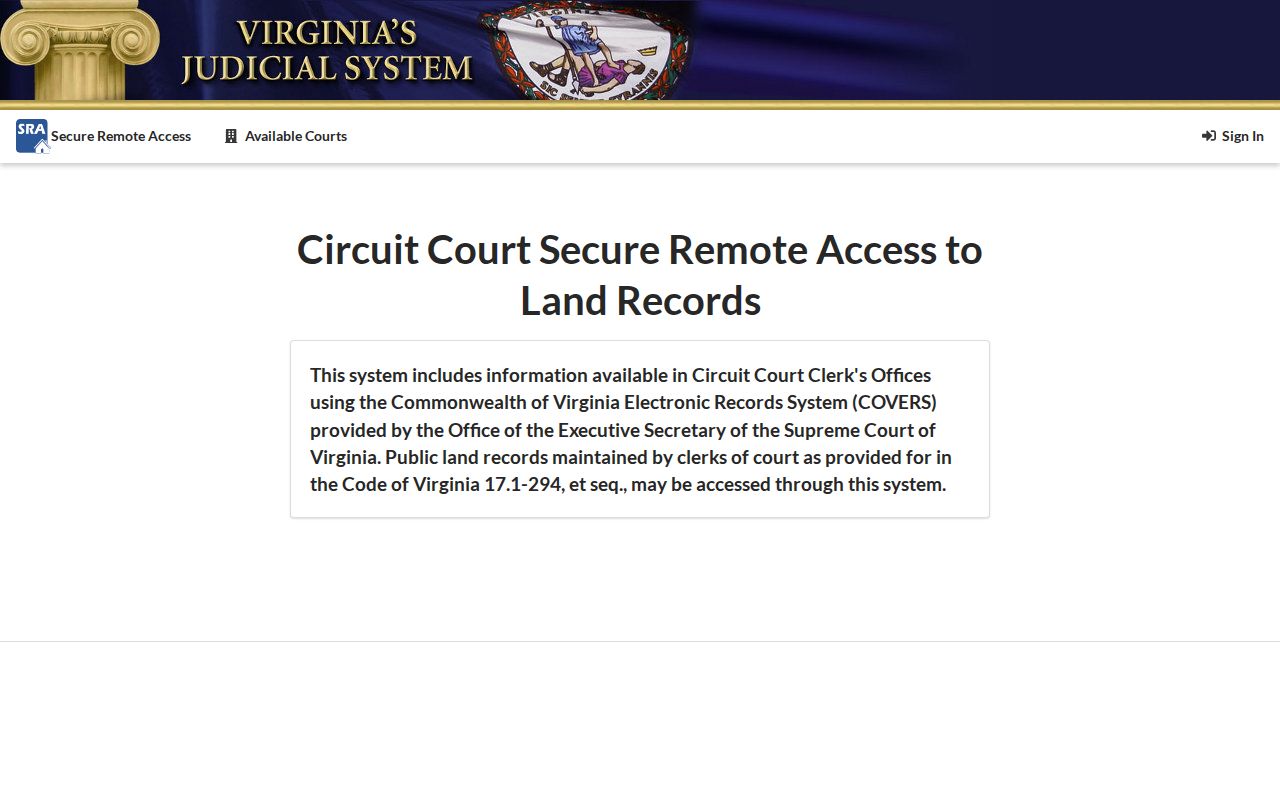
Two separate routes exist. The Circuit Court Clerk's own website is one. Virginia Secure Remote Access to Land Records is the other, and it may require local registration or acceptance of clerk terms. When the instrument is not online, the clerk's counter, mail service, or e-recording guidance still works. Ask the Historic Records Division whether a scanned or archival volume covers the period you need.
The Virginia Secure Remote Access to Land Records portal is the state's secure remote route, and its research notice sets no single fee or cutoff for every public user.
Confirm current access terms before trusting remote images.
Read the Pittsylvania Grantor and Grantee Chain
The grantor conveys the interest. The grantee receives it. Build a backward chain from the latest deed. Note the grantee, then find the earlier deed where that same party appears as grantee. Work back through each prior grantor, checking the legal description and recording reference at every step. A shared surname proves nothing, especially where one family name, estate, trust, or company shows up in several Pittsylvania transactions.
- Locate the latest deed using the parcel, legal description, or party names and save its book/page and recording date.
- Read the grantor and grantee roles and carry the prior grantor's name into the next search.
- Compare each prior legal description and instrument type so a similarly named but different tract is not added to the chain.
- Record any satisfaction, release, executor, administrator, or commissioner reference and follow it to the relevant land or probate file.
- If the online run ends, ask the clerk or Historic Records Division about deed books, reel/frame references, or microfilm.
- Grantor
- The party who conveys an interest in a recorded instrument.
- Grantee
- The party named as recipient of that interest.
- Chain of title
- The ordered sequence of recorded transfers and related instruments for the same land.
- Book/Page and Reel/Frame
- References that can identify the recorded entry or older microfilm image; confirm the exact citation with the clerk.
Old Pittsylvania Surveys Precede the Deed Books
Pittsylvania's oldest land-history source is Old Survey Book 1. Its first entry dates to February 1746. That predates the county itself by decades. Book 2 contains entries from around 1770, and Book 3 runs through 1820. These books describe surveys and land entries. They are not a modern parcel-number index, and the later chain may pass through a new road name, a subdivision, an estate, or a tighter metes-and-bounds description.
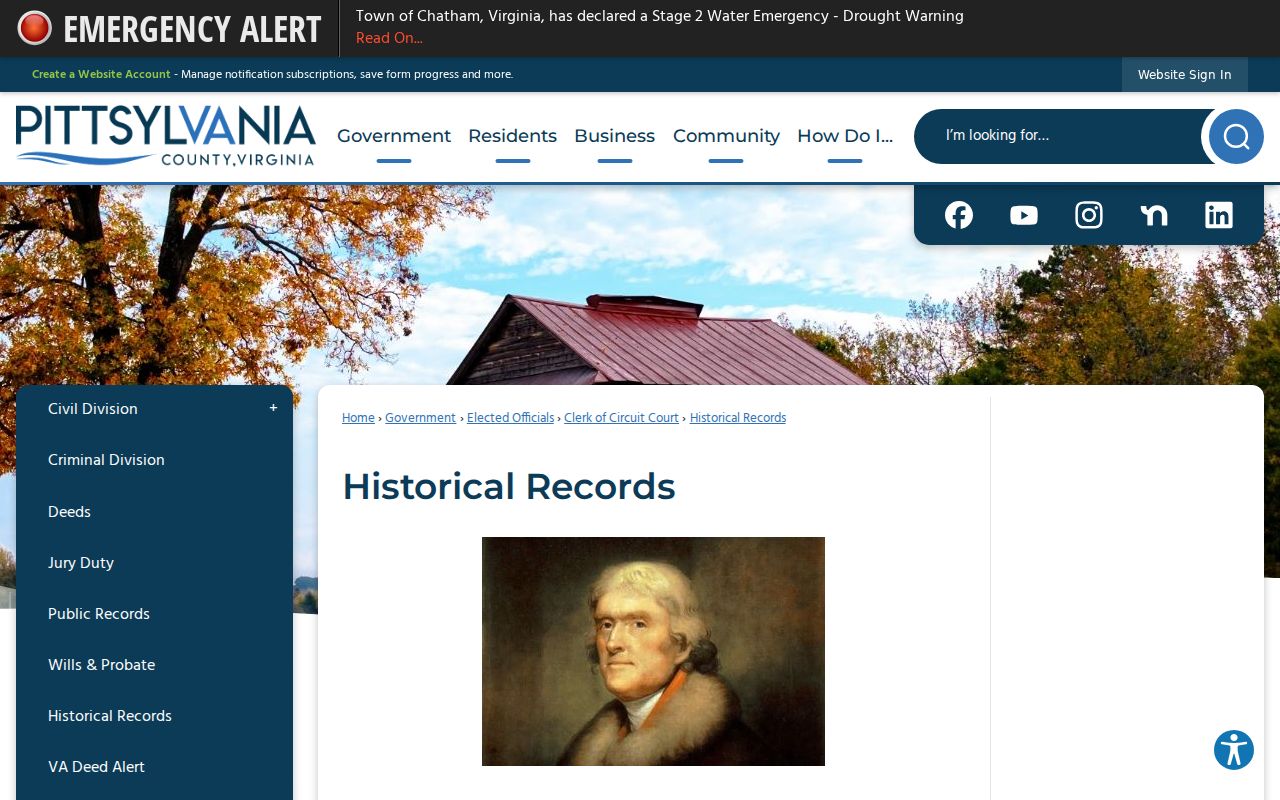
The Historic Records Division offers more than surveys. Selected marriage scans, Revolutionary War claims, the Register of Free Negroes from 1807 to 1865, and Library of Virginia collections all appear. Online marriages cover 1767 through 1787 plus selected years from 1887 to 1899. The archive welcomes researchers. Staff do not search or copy for visitors. Fragile records can also be unavailable while back-scanning skips damaged years.
The county's Historic Records page lays out the current archival route, and it describes the collection rather than promising that every volume is digitized.
When your dates miss a scanned run, ask about a deed book or Library of Virginia microfilm. Either one can bridge the gap.
Submission and Copy Routes Have Different Rules
Recording a deed in Pittsylvania County can happen several ways. The clerk accepts documents over the counter, by mail, and through e-recording. No land-record cover sheet is required. Every instrument affecting real property must show a parcel ID on page one. Mailed returns need a named recipient plus a self-addressed stamped envelope. Proper acknowledgment and a reproducible notary seal are expected, along with the standard document-format rules.
Fees are straightforward. Cash, check, money order, and card all work. Card payments add a $2 convenience fee at $50 or less. They add 4 percent above that. Copies are billed separately. Clerk copies run $0.50 per page, and certification adds $2 per instrument. Long documents or multi-instrument requests deserve a cost estimate from the clerk first.
The office sits at 1 North Main Street in Chatham. Researchers enter the courthouse complex from Bank Street. The deed room is open weekdays, 8:30 a.m. to 4:30 p.m. Staff will pull records for you. They cannot advise on title or trace a chain of ownership themselves.
Connect a Recorded Deed to a Case or Release
A Pittsylvania County deed chain often reaches beyond deed records. It may reach into probate, foreclosure, partition, judgment, or lien files. Virginia Court Case Information returns selected circuit-court results. Search there by locality, name, case number, or hearing date. Full pleadings stay with the clerk, though, and may be sealed, redacted, or archived. When an online case never appears, the courthouse public terminal is the fallback.
Read related filings with care. A lis pendens signals pending litigation, not that the plaintiff owns the parcel. A judgment entry alone does not prove a lien is still unpaid. Check the land-record index for a satisfaction or release before assuming otherwise. Estate or fiduciary references should lead you into the probate file. Federal matters go through PACER at the U.S. District Court for the Western District of Virginia.
For a current copy, start at the Circuit Court Clerk's office page. Follow its Deeds link for submission details. Older ownership history is traced in the former-owner guide, which walks the chain backward.
Get a Pittsylvania County Deed Copy From the Clerk
Gather your references before requesting a deed copy from Pittsylvania County. Party names, an approximate recording date, a parcel ID, the legal description, or a book and page reference all help. Any of these lets the clerk locate the instrument quickly. Remote access through WebPAAS or SRA may let you pull the image yourself. If nothing appears online, contact the Circuit Court Clerk. Ask whether the deed is open to counter inspection or available by written mail request. A known legal reference makes any copy order easier to fill. The clerk cannot run a title search or interpret the deed for you.
Recorded, not guaranteed. A Pittsylvania County deed index reports filings, not a legal opinion that title is clear. Unrecorded claims, unreleased interests, or later filings may affect a parcel, so use a title professional for a transaction.