
Build the Pittsylvania Ownership Timeline From Each Deed
A former-owner timeline is a chain of recorded transfers. It is not a roster of everyone who ever lived in the house. Pittsylvania County gives you two starting tools. The assessor card pins down the parcel and the current owner of record. The Circuit Court Clerk's deed index then supplies each grantor, grantee, recording date, instrument type, and land description. That is everything a backward step requires. The clerk publishes no clear boundary for online coverage. A complete deed records timeline may take more than one access channel to finish.
| Source | Years It Covers | Where Held | What It Shows |
|---|---|---|---|
| WebPAAS Deeds | Online cutoff not stated | County public portal | Deed-detail references, parties and recording fields when available. |
| Circuit Clerk land records | 1767-present custody statement | Chatham courthouse, mail, SRA | Recorded deeds and related land instruments; ask about online gaps. |
| Old Survey Books | 1746-1820 across three books | Historic Records / digitized links | Survey and land-entry clues predating or overlapping early deeds. |
| Historic scans and microfilm | Selected years; runs vary | County archive / Library of Virginia | Context where a deed image or older chain segment is not online. |
A modern transfer starts with the latest deed and the parcel card. An early tract calls for a different route. Ask the Circuit Clerk for book and reel references. Then turn to the Historic Records Division or Library of Virginia microfilm. The first survey entry dates to February 1746. That was before Pittsylvania County existed. Treat it as an early land clue rather than proof of an unbroken chain to a modern parcel.
Save Every Reference Before You Move to the Prior Owner
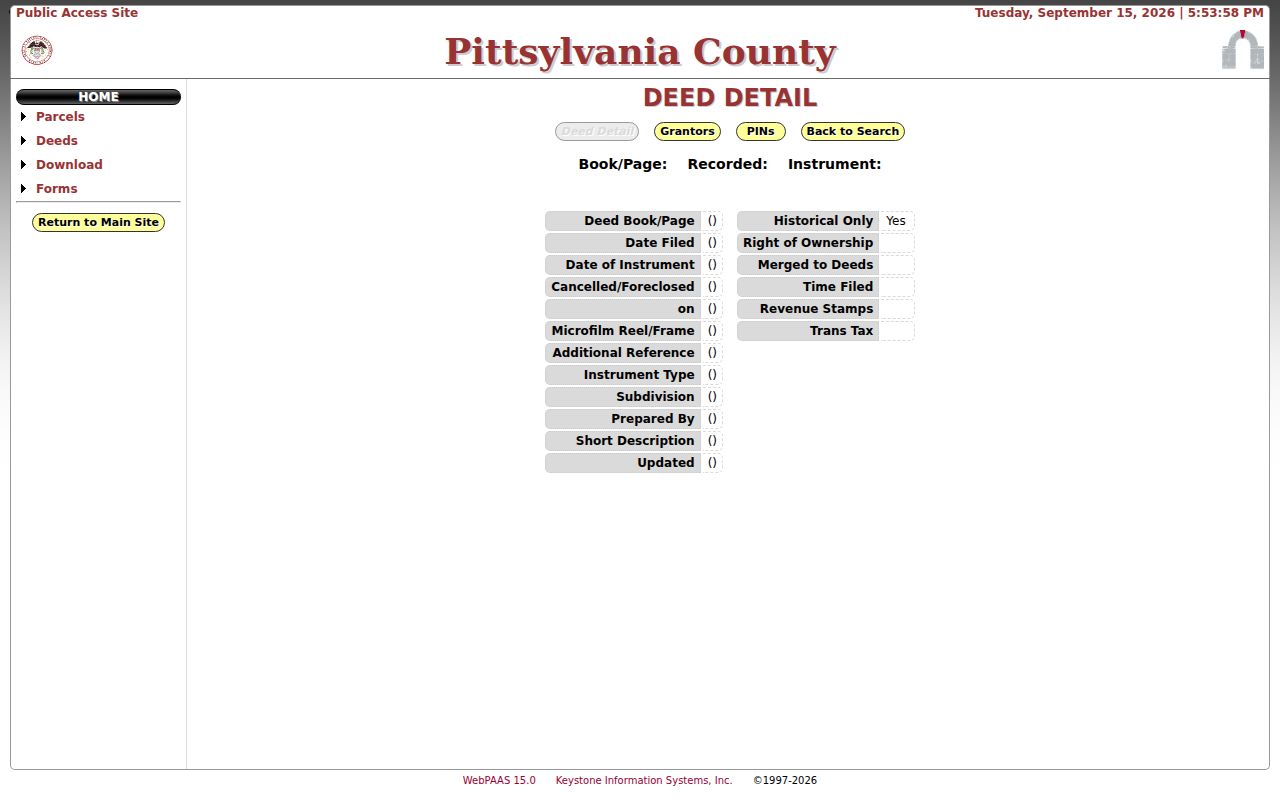
The WebPAAS deed detail view lists the fields you will meet on every instrument: Book/Page, Recorded, Instrument, Date Filed, Date of Instrument, microfilm reel and frame, Additional Reference, Instrument Type, Subdivision, Prepared By, Short Description, Historical Only, Merged to Deeds, and the transfer fields. Save those values along with the parties. Save the land description each time you add a link. A historical-only or merged-to-deeds flag can explain an older index conversion. The clerk should confirm how to pull the underlying instrument.
Build the chain table with one row per recorded transfer. Record the date, grantor to grantee, instrument type, and book/page citation. Mark gaps plainly. Never infer a sale price from revenue stamps or transfer-tax figures. Read the deed itself first. Understand the transaction.
The WebPAAS page displays those metadata labels rather than a filled-in sample deed. Use it to learn the field names before you search.
Write the citation beside each former owner's name. That habit lets you return to the exact transfer instead of repeating a broad property search on the same surname.
Step Backward Through Pittsylvania Grantors and Grantees
The chain always runs from the current grantee back to the prior grantor. Find the latest deed and copy the parties and legal description. Then search that prior owner as an earlier grantee. Keep stepping back only while the land description fits. A shared surname or a similar street name proves nothing about two entries describing the same tract. When the name shifts to an executor, administrator, commissioner, or estate, move into the related probate or court record for the real transfer.
- Start with the current parcel ID and the newest deed matching its legal description.
- Record the deed date, instrument type, grantor, grantee, and book/page or reel/frame.
- Search the prior grantor's name as an earlier grantee, testing spelling variants and initials.
- Compare the land description and subdivision or lot reference before adding that transfer to the timeline.
- Follow any estate, satisfaction, or court-directed deed into the related probate or case file.
- At the online boundary, ask the clerk which deed book, film, or archive source covers the next period.
- Grantor
- The party conveying the recorded interest.
- Grantee
- The recipient named in that instrument.
- Chain of title
- The ordered sequence of transfers tied to the same land.
- Legal description
- The land reference that can connect older tracts even when street names or mailing places change.
1767 Custody Does Not Mean 1767 Web Coverage
The Circuit Court Clerk reports keeping Pittsylvania County land records from 1767 to the present. That custody span is not a web span. The clerk's public page does not state the first year searchable online. The WebPAAS site does not state it either. Neither states the image cutover date. Keep the two ideas separate. Custody describes the county's holdings. A web index describes what a remote searcher can reach today.
The Historic Records Division is back-scanning older material. It warns that fragile volumes may cause some years to be skipped during processing. A missing scan is an access gap, not proof a transfer never happened. Ask the clerk about counter access or a written request. A record may exist as a scan. It may exist only in a bound volume. Ask the archive which is true.
No public source sets one grantor/grantee cutoff that fits every search. Confirm the period with the clerk before claiming an online chain reaches any particular year.
Survey Books Reach Back to 1746
Old Survey Book 1 opens in February 1746. Book 2 carries entries near 1770, and Book 3 runs to 1820. Pittsylvania County was formed in 1767 out of Halifax County. That means the earliest survey material describes the land. The county's later deed records system did not exist yet. Use the location, watercourse, road, or tract wording as a clue. Then connect it to later conveyances and a present parcel number.
The county archive offers digitized survey books and selected marriage material. It also holds Revolutionary War claims, the Register of Free Negroes from 1807 to 1865, and Library of Virginia resources. The Historic Records office welcomes the public. It does not perform research for visitors or make copies on demand. Delicate-record rules limit phones, laptops, and recording devices in the sensitive area. The Historic Records Division page describes the local scans. It also maps the archive route into these collections.
Before you assume a break in the chain, ask a simple question. Is the missing transfer sitting in a deed book, a scan not yet posted, or a related probate record?
Place-Name Changes Can Hide an Earlier Transfer
Place names in Pittsylvania County have shifted over the years. Chatham was Competition until the General Assembly renamed it in 1852. It incorporated as a town in 1874. The boundary expanded in 1882 to take in the railroad west of town. An old deed, directory, or survey may name Competition, Pittsylvania County Courthouse, Callands, or a rural post office. It may not use a modern street address. Match the parcel geography and legal calls to the deed. Do not trust the current name alone.
Gretna carries a layered charter history too. It was Elba first. The paper trail runs from the 1901 Elba charter through a 1914 name change. It continues through a 1916 Gretna charter and a later 1979 charter. Its current boundary is described from a Southern Railway depot chimney marker. A former-owner search limited to the present town name can miss older references entirely. Read the recorded calls with care.
Hurt's charter describes roads, utility easements, and Reed Creek. Those landmarks help orient older metes-and-bounds language. Never treat a modern ZIP or GIS label as a substitute for the recorded calls. The deed's recorded calls come first.
Estate Transfers Can Break a Simple Name Chain
An owner's death can break a simple name chain in the property records. The estate file may hold a will. It may also hold qualification papers, inventories, orders, and authority for a sale. A later executor's or commissioner's deed is often the link. That deed moves the parcel to a new grantee. Keep this distinction clear. A will shows intent. The deed is what actually transfers the land, so follow the probate file and the clerk's deed index together.
The Pittsylvania Circuit Clerk handles probate and estate administration. Probate appointments go through the clerk's office. The local court listing gives (434) 432-7890 for probate appointments. It also lists weekday hours of 8:30 a.m. to 4:30 p.m. If the estate file is not online, use the courthouse terminal. A narrow written copy request to the clerk also works. Vital records sit elsewhere. Recent death certificates carry access limits. Older records and indexes route through Virginia's Office of Vital Records and Library of Virginia materials.
Working one instrument at a time helps. The deed records guide explains clerk copy routes and the references worth saving.
How Far Back Pittsylvania Ownership History Can Reach
No confirmed year marks the online starting point for Pittsylvania ownership history. The county's historical custody reaches back to 1767. Its earliest survey clues begin even earlier, in 1746. Those are different records making different claims about coverage. A careful former-owner history names the source behind each step and marks every gap, rather than promising one uninterrupted online chain.
Lawful use. Former-owner research in Pittsylvania County can support house history, title review, estate work, and purchase diligence. Do not use a name or address to track or harass a living person.